Future Tech Driving Deep Space Travel by 2030
Introduction: A Decade of Acceleration
People have always gazed at the stars, curious and eager to learn more about the universe. For many years, traveling far into space was more of a dream than something we could do in a safe and lasting way. Our technology just wasn’t ready to take humans beyond the Moon. But that’s starting to change.
From 2020 to 2030, there have been major advances in several key areas—like how we move through space, how we build homes for astronauts, how robots help with tasks, how we keep people alive in space, and how we stay connected.
These breakthroughs are bringing us closer to making long–distance space travel a real possibility.
This article looks at the new technologies that will make deep space missions possible by 2030 and how they could change how we see our place in the universe.
1. Advanced Propulsion: Faster Journeys, Bigger Possibilities
Deep space travel begins with propulsion. Traditional rocket engines are powerful but slow, demanding vast amounts of fuel and long travel times for missions beyond Mars. By 2030, new propulsion systems will dramatically change how we move across the solar system.
1.1 Nuclear Thermal Propulsion (NTP)
- NTP engines use a nuclear reactor to heat hydrogen, which creates thrust in a more efficient way than chemical rockets.
Why it’s important:
It can cut down the time it takes to travel to Mars from six months to about two to three months. - It allows for carrying more cargo or supplies on the spacecraft.
- It offers a safer journey by reducing exposure to harmful radiation.
NTP could be the key engine that helps send humans to Mars for the first time.
1.2 Solar Electric Propulsion (SEP)
SEP systems use solar power to run electric thrusters. These systems are great for long journeys because they work well and last a long time.
Perfect for
- cargo transport
- robotic missions
- deep space exploration
By 2030, they will play a key role in missions that last a long time.
1.3 Fusion Propulsion (Early Prototypes)
Fusion propulsion is still in the early stages, but it might one day make trips to the outer planets possible within a human‘s lifetime.
Although it’s not expected to be fully ready by 2030, the initial models and testing will help build the way for a new kind of space travel that could change how we explore beyond our own solar system.
2. AI and Autonomous system

As we go further into space, it’s more important than ever for spacecraft to make their own decisions. For example, a message from Jupiter can take up to an hour to get to Earth — that’s way too slow for making quick decisions or fixing problems on the fly.
By 2030, AI will be doing a lot of important things:
- it will adjust the spacecraft‘s path on its own
- it will spot issues with the equipment before humans even realize there’s a problem
- it will use fuel and power in the best way possible
- it will manage the life support systems without needing human help
- it will look at scientific data while it’s still in space
- it will help astronauts during emergencies
AI will work like both a co–pilot and a mission manager, making deep space missions safer, more efficient, and much more on its own without needing constant instructions from Earth.
3. Radiation Protection: Safeguarding Life Beyond Earth

Deep space has a lot of harmful radiation and solar storms that can hurt electronics and damage human health. Once astronauts go beyond Earth’s magnetic protection, radiation becomes one of the biggest dangers they face.
By 2030, there are new ways to protect against this:
3.1 Magnetic Shielding
Using special superconducting coils, spacecraft can create their own magnetic fields, like Earth’s shield.
This helps push away charged particles and lowers the amount of radiation astronauts are exposed to.
3.2 Water and Hydrogen Protection
Water is really good at blocking radiation.
Future spaceships and living areas might use layers of water around the parts where astronauts live.
Hydrogen, which is in water, also helps protect against radiation.
3.3 Better Medical Help
New drugs could help fix cells that radiation damage or make the body stronger so it can handle long exposure.
Radiation is hard to avoid, but with these new technologies, it might be possible to stay safe and healthy during long space missions.
4. Life Support Systems: Creating Sustainable Space Living
Deep space missions need life support systems that can work for years without needing supplies from Earth. Old systems aren’t good enough. By 2030, space missions will depend on closed–loop recycling, where almost everything is reused.
Water recycling
New systems will recycle up to 98 to 99 percent of water using advanced filters and condensation methods.
Air Regeneration
For air, systems will turn carbon dioxide into oxygen using different methods like algae, bacteria, and catalytic reactors.
Growing food in space will also be important.
Missions will use hydroponics, aeroponics, specially modified plants, and small farms. This will help reduce the amount of food that needs to be carried from Earth and also help keep astronauts healthier.
In short, future spacecraft will act like small ecosystems.
5. In-Space Manufacturing: Building What We Need, When We Need It
One of the biggest challenges of deep space missions is that you can’t bring everything. Something will break—and you won’t have a replacement unless you make one.
5.1 3D Printing
By 2030, spacecraft will use 3D printers to create:
tools
mechanical parts
medical devices
replacement components
5.2 Using Local Resources (ISRU)
Future missions will gather resources on the Moon, Mars, or asteroids to create:
building materials
oxygen
water
rocket fuel
This technology will allow humanity to build and maintain structures far from Earth.
6. Advanced Habitats and Spacecraft Architecture
Deep space missions need more than rockets—they need homes. A spacecraft designed for six months around Earth isn’t enough for a three-year journey to Mars or beyond.
6.1 Inflatable Habitats
These expandable habitats save launch space and provide large living areas once deployed.
6.2 Artificial Gravity Systems
Rotating modules may simulate gravity, protecting astronauts from:
bone loss
muscle atrophy
organ weakening
6.3 Modular Spacecraft
Future spacecraft will be built like LEGO systems—swappable modules for living, science, propulsion, and cargo.
These innovations will make long missions safer, healthier, and more comfortable.
7. Robotics and Automated Assistance

Robots are set to become the labor force for deep space exploration, undertaking tasks that are either excessively hazardous or overly monotonous for humans.
7.1 Space Maintenance Robots
Robots will:
inspect spacecraft
repair damage
maintain external systems
assist with docking and cargo handling
7.2 Robots for Planetary Exploration
Before humans land on distant worlds, robots will:
scout terrain
test resources
map landing zones
build infrastructure
7.3 Humanoid Assistants
Future humanoid robots will help with:
heavy lifting
habitat construction
emergency repairs
The field of robotics will enhance human capabilities throughout the solar system.
8. Communication Breakthroughs: Connecting Across the Solar System
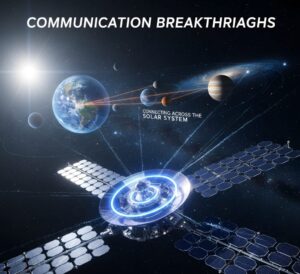
Deep space missions need strong and fast communication systems. By 2030, new technology will take over from the older radio–based methods.
8.1 Laser Communication
Laser-based communication provides:
- Much faster data sending, 100 times quicker
- More capacity for sending videos and scientific information
- Stronger and more dependable connections for space missions
8.2 Early Quantum Communication Research
Quantum-based systems could provide:
ultra-secure communication
more stable long-distance signals
potential new navigation methods
Fast and secure communication is critical for mission success—and for staying connected with Earth.
9. Reusable Rockets and Cheaper Access to Space
The journey to deep space begins with leaving Earth. Reusable rocket systems have already lowered costs dramatically, and by 2030:
heavy-lift reusable rockets
rapid launch turnaround
cheaper fuel systems
fully reusable spacecraft
will make deep space missions economically feasible.
Lower launch costs mean more missions, more innovation, and more opportunities for deep space exploration.
10. Resource Utilization: Turning Space Into a Supply Depot
Bringing everything from Earth is not sustainable. Future missions will use local resources through ISRU (In-Situ Resource Utilization).
ISRU enables:
extracting water from lunar ice
turning Martian atmosphere into oxygen
creating fuel from frozen hydrogen
using regolith for construction
mining asteroids for metals
By 2030, early ISRU systems will operate on the Moon and Mars, laying the groundwork for permanent human presence.
Conclusion
For the first time in history, humans have the tools to become a real spacefaring civilization. By 2030, with better engines, smart computers, the ability to build things in space, robots, protection from space radiation, and systems to keep people alive, traveling to deep space will stop being just something from movies and become something we can actually do. These technologies aren’t just for going to Mars—they will let us explore the whole solar system.
They will change how we live, work, and grow in space.
The stars are not just faraway ideas anymore.
They are places we can go—and our journey starts right now.