
How SpaceX Starship will transport humans to Mars in 2026

This engineering deep-dive is written for aerospace professionals, space enthusiasts, and anyone curious about the technical realities behind humanity’s next giant leap. You’ll discover how SpaceX plans to overcome the massive challenges of keeping people alive during a months-long journey through the vacuum of space, then safely landing them on another world.
The 2026 Mars mission is a big chance that happens only every 26 months when Earth and Mars are in the right positions for travel. SpaceX has been carefully testing Starship‘s systems, trying new things and getting better with each flight. Their fast way of improving means they’re learning and growing quicker than usual aerospace projects.
Getting humans to Mars is more than just making a bigger rocket. There are many engineering challenges, like protecting astronauts from radiation, creating life support systems that work perfectly for six to nine months, and making sure they stay safe from space debris and the mental strain of being far from Earth. The Starship needs to act as both a spaceship and a living space for the crew, keeping them safe from harmful radiation, small space rocks, and the stress of being in deep space alone.
The spacecraft was built using knowledge from the International Space Station, the Dragon capsule flights, and many unmanned Mars rovers. Each part of the spacecraft was designed with extra backup systems and reliability in mind, because once the crew is out of Earth’s orbit, there’s no way to bring them back.
We’ll start by examining Starship’s revolutionary design features that make Mars missions possible. The vehicle’s stainless steel construction, Raptor engines running on methane fuel, and massive payload capacity represent fundamental advances in spacecraft engineering. These aren’t just incremental improvements – they’re breakthrough technologies that change what’s achievable in space travel.
Another, we’ll break down the basic timeline points of reference SpaceX must hit to make the 2026 dispatch window. This incorporates completing orbital refueling shows, demonstrating long-duration life bolster frameworks, and executing effective uncrewed Damages landing tests. Each turning point builds on the past one, making a complex choreography of specialized accomplishments that must adjust impeccably.
Finally, we’ll dive into the essential life support systems that will keep the crew alive during their journey. These systems must recycle air and water with near-perfect efficiency, provide adequate nutrition for months, and protect against radiation exposure that could prove fatal. The engineering behind these systems represents some of the most sophisticated closed-loop environmental control ever attempted.
The 2026 Mars mission represents a pivotal moment in humanity’s quest to become a multiplanetary species. While the technical challenges are daunting, SpaceX’s proven ability to achieve bold objectives gives reason for optimism. The innovative engineering breakthroughs from this mission will not only facilitate human exploration of Mars but also establish the foundational technologies necessary for expanding human presence across the entire solar system.
This mission signifies far more than a technological milestone; it marks the dawn of humanity’s backup plan to secure our species’ survival beyond Earth. The engineering choices made today will shape how future generations of humans live and operate in space.
SpaceX Starship’s Revolutionary Design Features for Mars Missions
Using methane as fuel is a great idea for missions to Mars. Unlike usual rocket fuels, methane can be made on Mars by combining the planet‘s carbon dioxide from the air and water ice found underground. This process is called the Sabatier process. So, future trips to Mars can get fuel right there on the planet, which makes going back much simpler and cheaper.
Raptor engines work under very high pressure, more than 300 bar in the combustion chamber, which makes them some of the strongest rocket engines ever made. These engines can adjust their power levels, giving precise control during important parts of a mission, like getting into orbit or landing on a planet. They can also be turned on and off several times, which is necessary for the complicated maneuvers needed during the six to nine month trip to Mars.
Massive cargo capacity supporting extended human missions
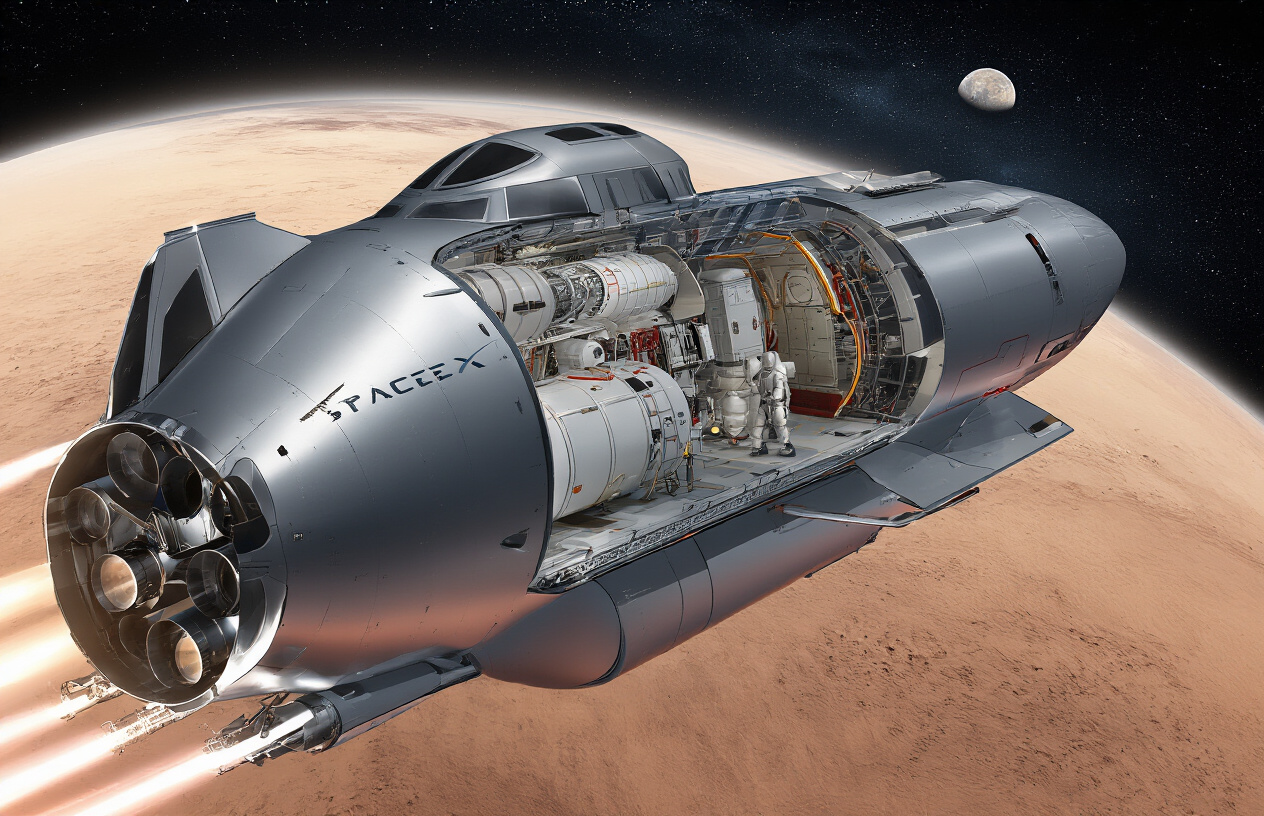
Starship has a huge inside space of about 1,000 cubic meters, which is much bigger than earlier spacecraft. This space is used for life support, where the crew can live, scientific tools, and enough food and supplies to keep a crew of 12 to 100 people safe during their long journey to Mars.
The pressurized volume includes dedicated areas for:
Crew living quarters with personal space and privacy
Exercise equipment preventing muscle atrophy in zero gravity
Medical facilities equipped for emergency surgery
Laboratory space for scientific research during transit
Food storage and preparation areas
Water recycling and waste management systems
Starship can carry as much as 150 tons of cargo to Mars in one trip. This amount of cargo can include backup life support systems, extra parts, building materials for habitats on Mars, and scientific tools. These items will help set up the first long–term human presence on another planet.
In-flight refueling capabilities extending mission range
SpaceX’s orbital refueling concept revolutionizes deep space missions by eliminating the tyranny of the rocket equation. Instead of launching with all fuel needed for the entire Mars journey, Starship reaches Earth orbit with minimal fuel reserves, then receives multiple tanker visits to top off its propellant tanks.
The refueling process involves automated docking systems that connect tanker Starships to the crew vehicle in Earth orbit. Each tanker delivers approximately 1,200 tons of methane and liquid oxygen, with multiple flights required to fully fuel the Mars-bound Starship. This approach allows the spacecraft to depart Earth orbit with maximum fuel capacity, providing flexibility for course corrections, orbital adjustments around Mars, and powered landing maneuvers.
Automated systems handle the complex fuel transfer operations, using proven technologies adapted from space station resupply missions. Safety protocols include multiple abort scenarios and backup systems protecting the crew during refueling operations.
Heat shield innovation protecting crew during atmospheric entry
Starship’s revolutionary heat shield system represents years of iterative design and testing. The spacecraft uses thousands of hexagonal thermal protection tiles made from advanced materials that withstand the extreme temperatures encountered during high-speed atmospheric entry.
Unlike traditional ablative heat shields that burn away during reentry, Starship’s tiles are designed for reuse. Each tile can survive multiple atmospheric entries, making them perfect for Mars missions where the spacecraft must survive entry into both Earth’s and Mars’s atmospheres during the mission profile.
The tiles on Starship cover the windward sides of the spacecraft and use active cooling to control how heat spreads. Special sensors check the tiles‘ performance in real time, sending important information to mission controllers and computer systems that can change the spacecraft‘s direction to shield damaged parts.
Entering Mars’ atmosphere is different from entering Earth’s.
Because Mars has a very thin atmosphere, the spacecraft needs to move at a different speed and experience a different amount of heating. This requires complex heat management plans and protection methods. SpaceX has tested these ideas using detailed computer models and real–world experiments at smaller scales.